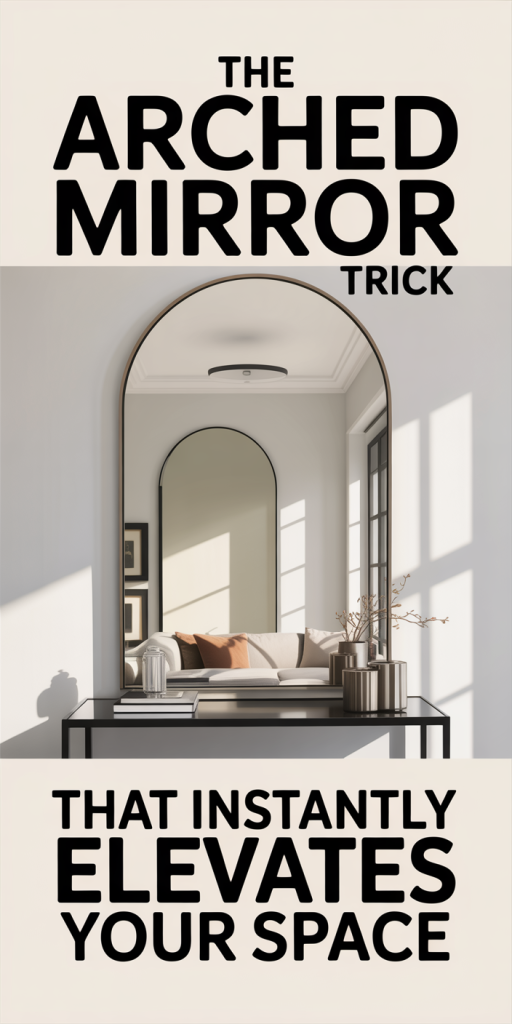
We’ve seen trends come and go, but the arched mirror has earned a permanent place in interiors for a reason: it’s an easy, high-impact move that changes how a room feels without a major renovation. In this guide we’ll explain why arched and curved mirrors work so well, the little placement and proportion tricks that make them read as intentional rather than accidental, and how to choose frames, finishes, and sizes that complement your home. Whether you want to add height to a low-ceilinged entry, double the daylight in a dim living room, or give a bedroom a quietly elegant focal point, the arched mirror trick is one of the simplest design investments with outsized returns. Read on, we’ll walk through practical rules, styling tips, common mistakes, and where to buy reliable options from budget-friendly to splurge-worthy.
Why Arched Mirrors Work So Well In Any Room
Arched mirrors succeed because they tap into several visual cues our brains use to read space: curvature suggests softness and motion, verticality implies height, and reflective surfaces amplify light and depth. Put together, these qualities make a compact object, one mirror, perform several design jobs at once.
Curves are psychologically approachable. Unlike a square or rectangle, an arch introduces a gentle, human-scale line that feels more organic and luxe. That soft silhouette is why arched mirrors frequently read as designer features even when they’re budget purchases. We find our eyes naturally trace the arch upward, which creates an impression of increased ceiling height and graceful flow.
On a practical level, curved mirrors reflect and redistribute light differently than flat-edged shapes. The arch’s top reaches into higher sight lines, catching and returning daylight or ambient light in ways that help brighten corners and hallways. In narrow spaces, an arched mirror placed thoughtfully can create a sense of depth without cluttering sightlines.
Finally, arched mirrors offer versatility. They play well with many styles, from traditional and French-country to modern minimalism and Japandi, because the shape is both historic and contemporarily relevant. That versatility makes them a safe, strategic choice when we want a single object to elevate an entire room’s aesthetic.

The Arched Mirror Trick Explained: Placement, Reflection, And Visual Weight
When we talk about the arched mirror trick, we mean more than “hang a pretty mirror and call it a day.” The trick is about thoughtful placement, using reflection intentionally, and balancing the mirror’s visual weight within the room.
Placement: The most powerful placements are opposite windows, near entryways, or behind seating. Opposite a window, an arched mirror doubles daylight and draws the outdoors inward, that’s instant ambiance. Near an entry, it introduces presence and checks sightlines so guests step into a space that feels larger and curated. Behind a sofa or console, the arch creates a focal layer that elevates even the simplest furniture arrangement.
Reflection: What the mirror reflects matters. We should avoid reflecting cluttered areas or unattractive elements. Instead, aim mirrors toward appealing views, garden layers, vignettes, architectural details, or interesting light fixtures. The arch’s curvature tends to soften the reflected image, which can be forgiving and flattering for portraits or dressing areas.
Visual weight: Arched mirrors carry a certain visual gravity. A large, dark-framed arch will anchor a wall like a piece of art: a slim, metallic arch will read lighter and more decorative. We balance that weight by considering scale and surrounding elements: pair a heavy arch with minimal furniture to prevent crowding, or use a lighter arch to add interest without dominating a small room. The trick is to make the mirror feel intentional, part of the design story, rather than an afterthought.
Choosing The Right Size, Shape, And Frame For Your Space
Selecting the correct size, shape, and frame is where the arched mirror moves from decorative to transformative. We start with size: generally, larger mirrors create more impact, but scale must respect the wall and furniture they accompany. A good rule of thumb is that a mirror over a console, mantel, or bed should be about two-thirds to three-quarters the width of the furniture beneath it. For full-height arches meant to visually raise ceilings, choose a mirror that reaches within 8–12 inches of the floor and tops out comfortably below any crown molding.
Shape nuances matter. A strict semicircular arch reads traditional and formal: a softer elongated arch with more vertical rise looks modern and elegant. Consider the proportions of the room: short, wide rooms can benefit from broader arches that emphasize horizontal space, while tall skinny rooms respond well to elongated arches that accentuate height.
Frame choices define the mood. Wood frames warm a space and pair well with natural or rustic interiors: painted frames can either blend into walls for a subtle look or contrast for a graphic statement. Metal frames, brass, blackened iron, or polished chrome, deliver a sleek, contemporary edge and reflect light off the frame itself, adding shimmer. Then there are frameless arched mirrors, which offer a minimalist, gallery-like presence and are excellent in modern bathrooms or dressing areas.
We also think about finish and detail. Antiqued mirrors with slight mottling add character and work beautifully in vintage or eclectic settings. Meanwhile, thin metal borders with mitred corners signal modernity. When in doubt, match the frame material to prominent metals in the room, lighting, hardware, or furniture legs, to keep the palette cohesive.
Measuring And Placement Rules To Maximize Impact
Accurate measuring prevents disappointment. Before you buy or hang an arched mirror, we measure both the wall and the furniture it’s meant to relate to, and mentally map the sightlines. A few straightforward placement rules help us squeeze maximum effect from every mirror.
Rule 1: Eye-line and focal relationship. When hanging a mirror for everyday use, in a dressing area or entryway, the center of the reflective surface should sit roughly 57–65 inches from the floor, which aligns with average eye level. For purely decorative mirrors where practical viewing isn’t necessary, placing the top of the arch closer to the ceiling can maximize perceived height.
Rule 2: Leave breathing room. Avoid cramming the arch into a crowded composition. Leave 2–4 inches between the mirror and moldings or adjacent artwork, and allow a proportional gap between the mirror and any furniture beneath it. Overly tight spacing makes a mirror feel like a worldly sticker: adequate spacing gives it presence.
Rule 3: Respect sightlines. Don’t place a mirror where it will reflect unattractive utilities, small TVs, or chaotic corners. Instead, angle or site the mirror to reflect light and architecture. In many cases, the most intentional placement is slightly off-center from a piece of furniture to create a layered, editorial look rather than a matched-for-museum symmetry.
Rule 4: Consider wall material and reinforcement. Large arched mirrors can be heavy: drywall anchors or studs are necessary. We always check backing and use appropriate hanging hardware rated above the mirror’s weight.
These measuring and placement rules give predictable results, but small adjustments, a few inches higher or lower, slightly left or right, can shift the perception of an entire room. We recommend dry-mounting paper templates to the wall to test positions before drilling.
Living Room And Entryway Placement Strategies
Because living rooms and entryways are social and functional zones, the arched mirror strategy focuses on light, first impressions, and focal balance. In an entryway, a single, well-placed arch directly opposite or adjacent to the door creates a gracious welcome. If space allows, pair the mirror with a narrow console, a tray for keys, and a small lamp: the mirror multiplies both light and vignette.
In living rooms, we often place an arched mirror above a mantel or sofa. Above a mantel, a centered arch reads like a framed artwork and adds seasonal flexibility: change the mantel vignette and the mirror keeps the composition grounded. Over a sofa, slight off-centering can feel more editorial. If you have a sectional, consider a tall arched mirror on the longest wall to balance the low, horizontal mass of seating.
In both rooms, use the mirror to capture an appealing reflection, a window view, art wall, or pendant fixture. When the arch reflects a window, it creates a layered view that expands the perceived depth. For living rooms with low ceilings, an arched mirror that extends vertically can be far more effective than installing new lighting: it visually lifts the room.
Practical tip: If you’re concerned about a mirror appearing too heavy over furniture, choose a slim metal or wood frame with a warm finish to keep the look grounded but not overwhelming.
Bedroom, Bathroom, And Dressing-Area Placement Strategies
Bedrooms and dressing areas call for a balance of beauty and utility. In bedrooms, the arched mirror often functions as both a decorative anchor and a practical dressing mirror. Over a dresser, choose a mirror that’s wide enough to create proportion with the dresser, again, roughly two-thirds to three-quarters the width, and place it so the top of the arch sits comfortably below any ceiling detail.
Full-length arched mirrors are invaluable for dressing areas. If you don’t have space for a built-in wardrobe mirror, lean an oversized arched mirror against a wall at a slight angle. Leaned mirrors bring casual elegance: they create a soft vignette and are easier to reposition than wall-mounted options. Ensure the bottom sits on a stable floor protector to avoid slipping.
Bathrooms are trickier due to moisture and scale. A large arched mirror above a double vanity makes the room feel larger and elevates a simple vanity to a design moment. Use a properly sealed or humidity-rated mirror and hardware to prevent corrosion. For small powder rooms, a single dramatic arched mirror can replace multiple decor items and make the space feel like a boutique bath.
Lighting considerations: In dressing areas and bedrooms, lighting at eye level is essential. If the mirror reflects a window, it will help with daylight: for evening routines, flank the arch with sconces or integrate LED backlighting to avoid harsh top-down shadows. We prefer soft, warm light for dressing, around 2700K to 3000K, which is flattering to skin tones and fabrics.
Safety note: If you’re leaning a heavy arched mirror, secure it to the wall with an anti-tip device. That small precaution prevents accidents and keeps the look intentional rather than precarious.
Hanging And Styling Tips For A Polished, Cohesive Look
Hanging and styling an arched mirror well turns it from an object into a room-defining element. We approach hanging like framing a painting: level, centered to the composition, and at an appropriate height. For heavy mirrors, use two hanging points attached to studs or quality anchors to prevent shifting.
Styling around the mirror is where personality comes in. Keep the area beneath the mirror clean and purposeful: a console with a single lamp and one or two curated objects looks better than a crowded tabletop. Mirrors pair beautifully with layered textures, a woven basket, a stack of books, or a sculptural ceramic. We aim for contrast in scale and texture: a slim-framed arch against plastered walls, or a heavy wooden arch softened with a linen runner.
Anchoring the mirror with lighting enhances its effect. Wall sconces mounted at about two-thirds of the mirror’s height, or a pair flanking the arch, create symmetry and illuminate the reflected view. If you prefer a more modern look, backlit mirrors provide soft, haloed light that’s both functional and atmospheric.
Another stylistic lever is repetition. If you have multiple small rooms or a long hallway, repeating small arched mirrors at intervals creates rhythm and a cohesive thread throughout the home. But don’t overdo it: varied frames or slight differences in size prevent the look from feeling like a factory.
Finally, embrace the mirror’s reflective power in decor choices. Position plants near the mirror to double their presence: use it to showcase an art wall from another angle: or let it capture evening candlelight for a warm, enveloping glow. When we style mirrors, we think in layers, the mirrored surface is just one layer that interacts with furniture, lighting, and accessories to create atmosphere.
Common Mistakes To Avoid When Using Arched Mirrors
Arched mirrors are forgiving, but a few common missteps can blunt their impact. We’ve seen these mistakes in real homes, and avoiding them will save time and money.
Mistake 1: Choosing the wrong scale. Too small and the mirror looks like an afterthought: too big and it overwhelms the space. Always measure and visualize with templates before purchase.
Mistake 2: Reflecting the wrong thing. Mirrors that bounce back clutter, utility boxes, or unattractive HVAC units defeat their purpose. Pretend you’re framing a photograph, what you reflect should be as considered as any artwork.
Mistake 3: Ignoring mounting specifications. A heavy arched mirror hung on inadequate anchors is both unsafe and likely to tilt over time. Use hardware rated above the mirror’s weight and secure to studs when possible.
Mistake 4: Mismatched style. While arched mirrors are versatile, pairing a highly ornate gold arch with ultra-minimalist décor can feel dissonant. We recommend aligning the mirror’s material and finish with key elements in the room: lighting fixtures, cabinet hardware, or furniture legs.
Mistake 5: Poor lighting. Mirrors amplify light, but they don’t replace proper task lighting. Don’t rely on a mirrored surface to do the work of vanity lighting or reading lamps, instead, use the mirror to enhance existing light sources.
Avoiding these errors will keep an arched mirror reading as a purposeful design decision rather than a styling shortcut.
Where To Buy Arched Mirrors And Budget-To-Splurge Options
We like to recommend retailers and makers across a range of budgets, so you can find a quality arched mirror whether you’re decorating a rental or outfitting a new build.
Budget-friendly options: Big-box and fast-furniture stores now offer handsome arched mirrors at accessible price points. Look for retailers that provide verified customer photos, they’re invaluable for judging true scale and finish. For a budget arc, choose a simple, thin metal or molded composite frame: these are lightweight, easier to hang, and often come in multiple finishes.
Mid-range: Specialty home retailers and online boutiques typically offer better materials and craftsmanship. Here you’ll find solid wood or genuine metal frames, hand-finished details, and tempered glass. These options balance durability with design-forward shapes and are ideal for living rooms, entryways, and bathrooms where the mirror will be central to the composition.
Splurge and artisanal: For a statement piece, consider working with a small studio or artisan maker who can customize dimensions, frame material, and glass treatments (such as antiqueing or low-iron glass). Custom mirrors are worth the investment when scale or finish will make or break the room’s design. High-end furniture showrooms and local framers often offer bespoke services and installation.
Sourcing tips: Always request a sample of the frame finish when possible, and check the glass specification (low-iron for the truest reflection, tempered or sealed for bathrooms). For online shopping, verify return policies and delivery protection, large mirrors can be damaged in transit. We also recommend reading reviews specifically about hanging and durability: a beautiful mirror that warps or hangs crooked will cost more in frustration than a slightly pricier, sturdier alternative.
Brands and places we’ve had consistent success with include a mix of national retailers and smaller workshops. If you want tailored recommendations based on your specific room dimensions and style, we’re happy to suggest options after a quick room description.
Conclusion
The arched mirror trick is simple but strategic: the right arch, placed thoughtfully, amplifies light, suggests height, and injects instant style. We’ve covered why curved mirrors resonate, how to choose scale and frame, practical measuring and hanging rules, room-specific placement strategies, common pitfalls, and where to buy. When we approach mirrors as deliberate design tools, not just decorative afterthoughts, they repay us with atmosphere and function.
If you’re decorating a room, start with a template on the wall and test a few placements. Lean on the mirror to frame a great view, pair it with complementary finishes, and use lighting to make the reflection sing. With a little care, an arched mirror will lift a space dramatically, often for a fraction of the cost of structural changes. We can’t promise it will fix everything, but it will change how the room feels, and that’s the whole point.
Leave a Reply