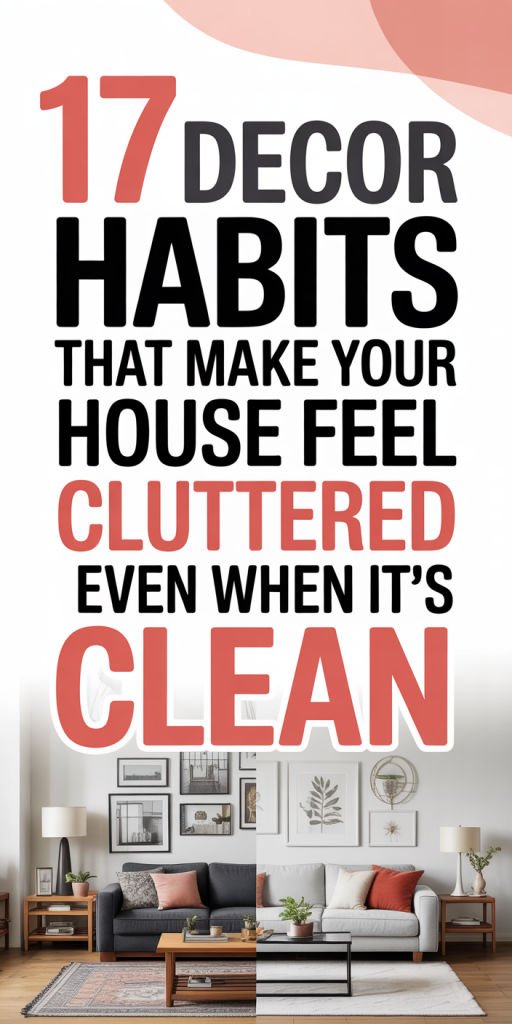
We keep our surfaces wiped, linens folded, and floors vacuumed, yet our homes still feel busy, chaotic, or suffocating. That’s because visual clutter isn’t the same as dirt. It’s a language our brains read: too many objects, competing patterns, inconsistent scale, and visible ‘necessities’ all shout for attention even when everything’s technically tidy. In this piece we walk through 17 common decor habits that make a home feel cluttered and, more importantly, how to edit them away so our spaces feel calmer and more intentional in 2026. Expect practical rules, quick edits you can do in an afternoon, and principles that keep personality without the visual noise.
Overloaded Surfaces: Why Flat Spaces Read As Busy
We think a cleaned tabletop equals calm, but layered items across flat surfaces create a visual field that never rests. When every horizontal plane, coffee table, console, kitchen island, dresser top, is covered with a mix of objects, our eyes have nowhere to land. The result: a feeling of constant activity even though nothing is dirty.
Why this happens
- Horizontal surfaces are primary sightlines. When you enter a room your gaze naturally travels across them, so clutter there becomes clutter everywhere.
- Mixed object types (books, candles, plants, mail) create micro-conversations. Instead of a single visual statement they argue with each other.
- Repetition without rhythm reads as chaos. Ten unrelated items scattered across a console are louder than three curated pieces placed with intention.
Quick edits that change the room’s “volume” immediately
- Apply the 3-2-1 rule: aim for no more than three objects in each cluster, organized in groups of three, two, and one by height or scale. That creates rhythm instead of randomness.
- Create negative space deliberately. Leave at least one flat surface largely empty: even a purposeful empty spot calms the whole room.
- Use trays and shallow bowls to corral small items. Rather than scattering, grouping on a tray reads as a single element.
- Rotate display objects seasonally. Keep a short-term rotation box: swap items monthly to avoid accumulation.
Styling principles to adopt
- Think in layers: base (large item like a book stack), middle (plant or sculptural object), and top (small accent). This layered approach keeps surfaces from feeling “flat noise.”
- Limit materials per surface. If you have glass and brass on a table, avoid adding ceramics unless they’re color-coordinated.
A practical afternoon exercise
Pick one prominent surface and edit it down to three objects. Photograph before and after. The contrast will show how much visual weight a few small choices can remove. Once we do the exercise in one spot, the rest of the house feels easier to tackle.
Too Many Small Decorative Objects And Trinkets
We adore souvenirs, gifts, and the little things that make a house feel like ours, but when every shelf and mantel becomes a museum of tiny items, the overall effect is clutter. Small objects are deceptive: individually they’re charming, but collectively they create a noisy texture that’s hard to ignore.
Why tiny objects accumulate
- Sentimentality: we’re emotionally attached and hesitate to remove items.
- The ‘it will look better with something’ trap: we add another small piece to fill a perceived gap, and soon there’s no gap left.
- Scale blindness: small items demand proximity to be appreciated, so placing many of them at eye level overwhelms the viewer.
How to edit without losing meaning
- Choose a few display narratives. Instead of showing all trinkets, pick two storytelling themes per shelf (family travel, pottery, vintage tools). Group similar items together rather than scattering them.
- Use repetition for calm. Display three similar objects rather than six different ones. Repetition creates visual unity.
- Photograph and store. For objects kept for memory rather than display, a high-quality photo in a digital album preserves the memory without occupying visual real estate.
- Invest in a single landmark piece per shelf. A sculptural object, oversized book, or framed photo anchors the space so smaller objects subordinate rather than compete.
Editing tactics
- The one-in-one-out rule: for every new decorative purchase, let one item go. This simple habit prevents the collection from ever growing disproportionately.
- Set a tiny-object budget: decide we’ll keep no more than four small items per shelf or vignette. Enforce with shelf dividers or decorative boxes to physically limit capacity.
When objects matter most
Keep sentimental items in rotation rather than permanent display. A small, curated rotating cabinet or a closed-front bookcase lets us showcase treasured pieces without visual overload. That balance preserves sentiment while safeguarding calm.
Hidden Storage Is Missing: Visible Necessities Create Visual Noise
Open storage solutions are fashionable, but they expose the tools of daily life, mail, chargers, cleaning supplies, kids’ artwork. When functional items are visible, they interrupt the decor narrative and turn our rooms into operating stations rather than restful spaces.
Problems caused by missing hidden storage
- Everyday necessities create clutter patterns. The things we use most are also the easiest to leave out.
- Open shelving tempts accumulation. If every shelf is a display case, it will be filled with both decorative and practical items indistinguishably.
- Mismatched containers and visible cords add friction to an otherwise composed aesthetic.
Smart storage strategies that restore calm
- Prioritize closed-front cabinetry in high-use zones. Kitchen counters, entryways, and living-room consoles benefit most from concealed drawers or doors that hide the practical stuff.
- Designate daily-use bins. A single, attractive basket or drawer for daily mail, keys, and chargers keeps essentials contained.
- Hide cables with simple hardware: cord clips, small cable boxes, or built-in grommets. Eliminating visible cords drops a room’s perceived clutter dramatically.
- Use furniture with built-in storage: ottomans, benches with lids, and coffee tables with drawers both serve function and reduce visible noise.
Aesthetic plus utility
We don’t have to sacrifice style for storage. Choose cabinetry and baskets in finishes that echo the room’s palette. Matching a woven basket to the sofa throw, or selecting drawer faces that read like furniture instead of cabinets, integrates storage as part of the design rather than an afterthought.
A weekend project
Audit every visible container and surface for functional items. Move anything that’s used less than daily into closed storage. The immediate result is often a calmer room and a clearer sense of what we actually use.
Mixing Too Many Patterns, Colors, Or Finishes
A lively mix of texture and pattern gives a room personality, but when we ignore proportion and connection, the result is visual static. Our brains look for relationships: repeating colors, complementary patterns, and coherent finishes. Without those ties, variety becomes chaos.
Why overloads happen
- Desire to keep things interesting leads us to add more patterns rather than edit what’s already working.
- Thinking ‘more = richer’ without considering how patterns scale relative to each other.
- Buying pieces separately over time without a unifying palette or finish plan.
How To Edit Patterns And Color Without Losing Personality
How To Edit Patterns And Color Without Losing Personality
- Start from a dominant neutral. Choose a grounding color or texture that occupies roughly 60% of the room (walls, large rug, main sofa). This neutral anchor gives us permission to add variety elsewhere.
- Use the 60-30-10 rule for distribution. 60% dominant color/texture, 30% secondary, 10% accent. That keeps visual balance without restricting palette.
- Control pattern scale. Pair one large-scale pattern, one medium, and one small. For example: a large geometric rug, medium striped curtains, and small-scale patterned pillows. This creates hierarchy and lets each pattern breathe.
- Keep a shared color thread. Even wildly different patterns will read cohesive if they share one or two colors.
- Limit saturated colors to accent doses. Bright hues are powerful, use them sparingly so they energize rather than dominate.
Simple Rules For Choosing Finishes And Palette Limits
Simple Rules For Choosing Finishes And Palette Limits
- Pick two dominant finishes (e.g., matte wood and brushed brass). Use a third as an accent if needed. Too many metals or wood tones fragment the look.
- Match finish warmth. If most of our metals are warm (brass, bronze), avoid adding cool metals (chrome) unless we intentionally want contrast.
- Use texture to substitute for additional colors. A chunky knit throw or a rough linen pillow can add depth without introducing another hue.
- Create a mood board before buying. A quick phone collage of existing items helps prevent mismatched additions.
A calibration exercise
Lay three representative items on the floor (rug swatch, throw, lamp). If they look like they belong in separate rooms, edit until there’s a thread connecting them, color, finish, or texture. This small test prevents pattern and color overload before purchases are permanent.
Scale Issues: Furniture That’s Too Small, Too Large, Or Overstocked
Scale determines how objects relate to the room and to each other. Pieces that are too small feel fussy and can make a space appear cluttered because they multiply visually. Conversely, oversized furniture can dominate awkwardly and force us to pack the rest of the room with smaller items.
Common scale mistakes
- Too many small items filling a large room. A dozen small tables, stools, and chairs fill the eye without providing a restful focal point.
- Oversized furniture blocking sightlines. A massive sectional placed incorrectly breaks the room into disconnected zones that feel crowded.
- Unbalanced groupings. A low coffee table paired with towering floor lamps and tiny side tables creates tension rather than harmony.
How to correct scale problems
- Measure before you buy. Use painter’s tape to map out proposed furniture footprints on the floor. Seeing the shape at actual size prevents regrettable purchases.
- Choose fewer, larger pieces over many small ones. One well-proportioned sofa and a single substantial coffee table often read cleaner than multiple small seating options.
- Maintain sightlines. Arrange furniture so we can see across the room to the focal point (a window, fireplace, or artwork). Open sightlines give the sense of space even in smaller rooms.
- Balance vertical and horizontal weight. If we have tall bookcases on one wall, counter with a low, long console on the opposite side to stabilize the room visually.
Smart grouping for less visual busyness
- Anchor seating with a rug sized for the furniture, not just the coffee table. Rugs that are too small fragment the space into disjointed islands.
- Edit the number of side tables. We don’t need a table next to every seat: choose two good ones and use ottomans or shared surfaces instead.
A practical edit
Walk through the room and remove the smallest or most decorative piece you find. Chances are the room will feel more spacious. If it doesn’t, try replacing two small pieces with one medium-sized item and observe the difference.
Conclusion
Visual clutter hides in habits more than dust. By editing overloaded surfaces, reducing tiny-object noise, integrating hidden storage, controlling pattern and finish variety, and getting scale right, we create rooms that feel calm even when life is lived in them. Start with one surface, one shelving edit, or one furniture swap, small, intentional changes compound. Our homes should support our days, not demand our attention. With these 17 habits in mind, we can edit for calm in 2026 without losing the personality that makes a house our home.
Leave a Reply