Microcement has become one of the most ubiquitous finishes in contemporary interiors, and for good reason. In 2026, designers are using this ultra-thin cementitious coating not just for its smooth, minimalist aesthetic but for its versatility, speed of application, and ability to create continuous surfaces that read as luxury. We’ll walk you through what microcement is, how it’s made and applied, and, crucially, the aesthetic tricks professionals use to make it sing. Whether you’re renovating a bathroom, specifying finishes for a hospitality project, or just curious about trending materials, this guide breaks down practical tips and real-world uses so you can get the seamless modern look without guessing.
What Is Microcement And Why Designers Love It
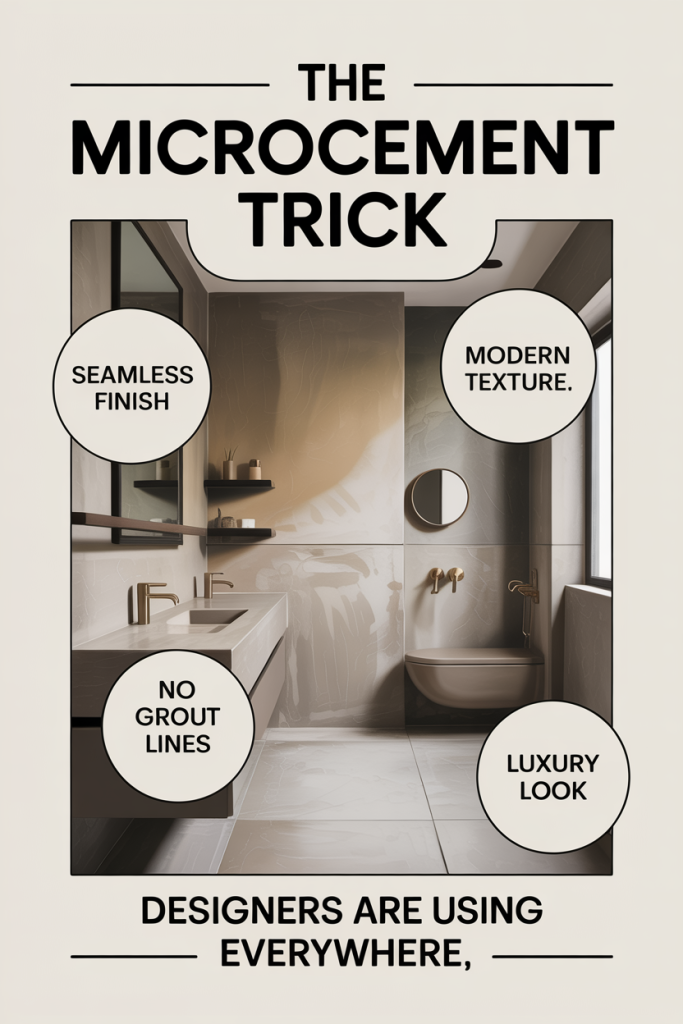
Microcement is a decorative cement-based coating, typically applied in very thin layers, usually between 2 and 3 millimeters total, over an existing substrate. It’s composed of cement, fine aggregates, polymers, and additives that improve adhesion, flexibility, and water resistance. Designers favor it for the way it creates continuous, monolithic surfaces that erase the visual interruptions of grout lines, baseboards, and threshold transitions.
Why do designers love it? First, it delivers that modern, pared-back aesthetic instantly: surfaces look like polished concrete but without the need for heavy structural topping or saw-cut joints. Second, the system is adaptable, applied over concrete, tiles, drywall, plywood, and even radiant-heated floors, which keeps demo costs down and timelines tight. Third, it’s highly customizable: pigments, sealers, and application techniques allow us to dial tone and texture with precision. Finally, when specified correctly, microcement performs well in high-traffic spaces and wet areas, making it a practical as well as an aesthetic choice. In short, it’s the shortcut to seamless modernism that still allows genuine craft and nuance.
The Aesthetic Tricks Designers Use To Make Microcement Pop
What separates a factory-finish surface from a truly compelling microcement application isn’t just the material, it’s the strategies designers and skilled applicators use to shape light, depth, and tactile perception. We focus on layering color, manipulating tool marks, and designing transitions so surfaces feel intentional rather than insipid. These are the subtle moves that make microcement read as high-end rather than just a cheap overlay.
A few recurring tactics have emerged in our projects: using underlayers of contrasting tones to give depth, selectively burnishing or dulling areas to direct reflection, and aligning float direction or subtle veins with architecture to make the space feel cohesive. Lighting strategy is another non-negotiable, microcement responds to light differently than tile or wallpaper, so we coordinate finish sheen and color with daylight and fixture positioning. Below we explore the specific techniques, color layering, texture control, and seamless transitions, that deliver the polished, modern look clients increasingly want.
Practical Applications Around The Home And Commercial Spaces
Microcement is versatile enough to be applied across residential and commercial contexts, and designers are experimenting with it in ways that go beyond floors and walls. Because it adheres to many substrates and comes in a range of finishes, we use it to unify disparate materials, create integrated fixtures, and deliver a consistent material language across an entire project. Below we outline the most successful applications and what to watch for in each scenario.


Leave a Reply