We’ve all been in a room that feels sharp, clinical, or just… uninviting. Often it’s not the furniture or the paint, it’s the lighting. In 2026, with more lighting options and smarter bulbs than ever, a simple shift to warm lighting can transform a harsh room into a cozy, flattering space in minutes. In this guide we’ll show why cool, blue-heavy light creates that unfriendly vibe, what the “warm lighting trick” really is, and how to apply it fast with bulbs, fixtures, and layering tactics that work in real homes. No jargon, no expensive renovations, just practical, design-backed steps that give immediate results.
Why Harsh Lighting Makes Rooms Feel Cold And Unwelcoming
Harsh lighting usually means light that’s too bright, too blue, or too focused in the wrong places. Commercial-grade fluorescent tubes, high-Kelvin LEDs, and unshaded recessed cans are common culprits. Psychologically, blue-white light stimulates alertness and mimics daylight: that’s useful in offices, but in living rooms, bedrooms, and dining areas it can make surfaces look washed-out and people appear sallow.
There are three overlapping reasons a room feels “harsh.” First, color temperature: light above ~4000K tends toward blue, which reduces warmth and intimacy. Second, contrast and glare: a single bright source in a dark room produces sharp shadows and visual discomfort. Third, spectral quality: cheap bulbs with poor color rendering can distort colors and skin tones, making everything look unnatural.
We should also account for context. A room painted in cool grays or whites will accentuate blue lighting: conversely, warm-toned walls can clash with cool bulbs and create visual dissonance. Reflective surfaces, glossy floors, mirrors, stainless steel, amplify glare and make light feel clinical. Finally, our expectations matter: we associate warm light with evening, comfort, and relaxation, whereas bright white light reads as “task mode.” When those cues clash with a room’s function, it feels unwelcoming.
Understanding these causes helps us fix the problem without gutting the space. The warm lighting trick targets color temperature, diffusion, and layering, the three levers that change a room’s mood quickly and cost-effectively.
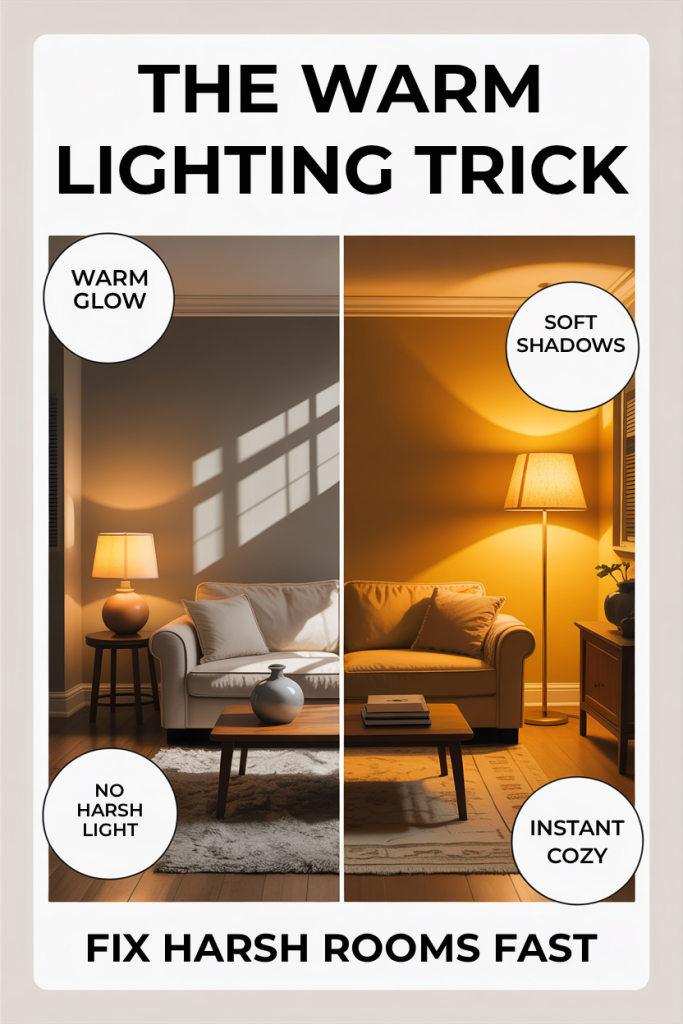
The Warm Lighting Trick: What It Is And Why It Works
The warm lighting trick is straightforward: shift primary light sources toward warmer color temperatures (lower Kelvin), improve diffusion to reduce glare, and layer light so illumination feels even and intentional. It’s not about making everything dim, it’s about changing the quality of light so materials and faces look better.
Why this works comes down to perception and physiology. Warm light (roughly 2200K–3000K) increases perceived coziness because it contains more red and amber wavelengths that our brains associate with sunsets, firelight, and candlelight. These wavelengths flatter skin tones, deepen textures, and soften shadows. Diffused light spreads more evenly, reducing hard-edged shadows that feel “harsh.” Layering provides the right brightness where we need it while keeping the overall scene gentle and three-dimensional.
We’ve seen this in practice: swapping a single cool 4000K fixture for a 2700K pendant plus table lamps and an accent fixture instantly changed a room from sterile to hospitable. The trick is efficient and reversible, no repainting required. It’s compatible with smart bulbs too, so you can tune scenes for day and night. The rest of the article breaks the trick into actionable steps so we can assess, pick products, and carry out changes based on room function and budget.
How To Assess Your Room’s Lighting Needs Quickly
Before buying bulbs or fixtures, take a quick diagnostic tour. We recommend a 7-point assessment that takes less than ten minutes and gives a clear plan.
- Identify the room’s primary functions. Is it for relaxing, dining, working, or circulating? Rooms used for relaxation benefit most from warm light: task areas may need a warmer ambient layer plus cooler task lighting.
- Note current bulb temperatures and types. Look at existing bulbs or fixtures, plastic diffusers, exposed LEDs, fluorescent tubes. If a bulb is labeled 4000K or higher, it’s likely contributing to a harsh feel.
- Observe glare and shadows. Stand in different parts of the room and look for bright spots, reflections in glass or TVs, and deep shadows behind furniture. Harsh rooms often have high contrast ratios between bright sources and dim areas.
- Check color rendering (CRI). If colors look “off” or skin tones appear washed, the CRI may be low. We prefer CRI 90+ for living spaces to maintain natural color.
- Assess wall and surface tones. Cool-toned walls or reflective surfaces amplify blue light. Make note of significant reflective elements, large windows, mirrors, glossy floors, or metal appliances.
- Measure light levels roughly. Use your phone’s light meter app or estimate: a bright living room might be ~150–300 lux, while task zones like kitchens need more. The exact numbers aren’t critical here: we just want to know whether the room is underlit, overlit, or patchy.
- Consider fixture placement and switches. Do you have flexible circuits or only a single central switch? Can you add plugs, floor lamps, or smart bulbs? Layering relies on ergonomic control, so wiring limits will guide our approach.
After this quick assessment we should have a checklist: current Kelvin/CRI, problem areas (glare/shadow), surface tones, and control limitations. Armed with that, we can choose bulbs and layering strategies that deliver the warm lighting trick without guesswork.
Practical Steps To Implement The Warm Lighting Trick
Now we convert the assessment into action. The implementation has three parallel tracks: swap or adjust bulbs, change diffusion and fixtures, and layer light for flexibility. We’ll walk through budget-friendly to premium options so you can apply the trick immediately.
Common Mistakes That Undermine Warm Lighting Efforts
Even with good intentions, people often make predictable errors when trying to warm up a room. We want to call these out so we can avoid them.
Mistake 1: Replacing only one bulb and calling it a day. A single warm bulb in a sea of cool sources will create mismatched color and uneven lighting. Aim to change the primary ambient sources first.
Mistake 2: Choosing the wrong Kelvin for the room. Over-warm bulbs (below 2200K) can make a room feel orange and gloomy, while too-cool bulbs (4000K+) keep the space feeling clinical. For most living areas, 2700K–3000K hits the sweet spot.
Mistake 3: Ignoring CRI. Low-CRI bulbs save money but make colors and skin tones look off. For living rooms and kitchens, we recommend CRI 90 or higher.
Mistake 4: Forgetting diffusion. Exposed LEDs or bare bulbs cause glare and harsh shadows even if the Kelvin is warm. Use shades, diffusers, or frosted bulbs to soften the beam.
Mistake 5: Not layering. Relying on a single overhead fixture creates flat, utilitarian light. Combine ambient, task, and accent light to add depth and control.
Mistake 6: Dimming without the right dimmer. Not all dimmers work with all LEDs. Use compatible LED dimmers or smart bulbs to avoid flicker or limited dimming ranges.
Mistake 7: Overcompensating with décor. Changing wall colors, rugs, or furniture can help, but these are costly ways to fix what lighting can solve more simply. Start with the bulbs and layering first.
By spotting these common missteps up front we save time and money. The warm lighting trick isn’t a mystery: it’s a sequence: choose the right Kelvin and CRI, diffuse and soften, then layer and control. Skip a step and the room won’t reach its potential.
Conclusion
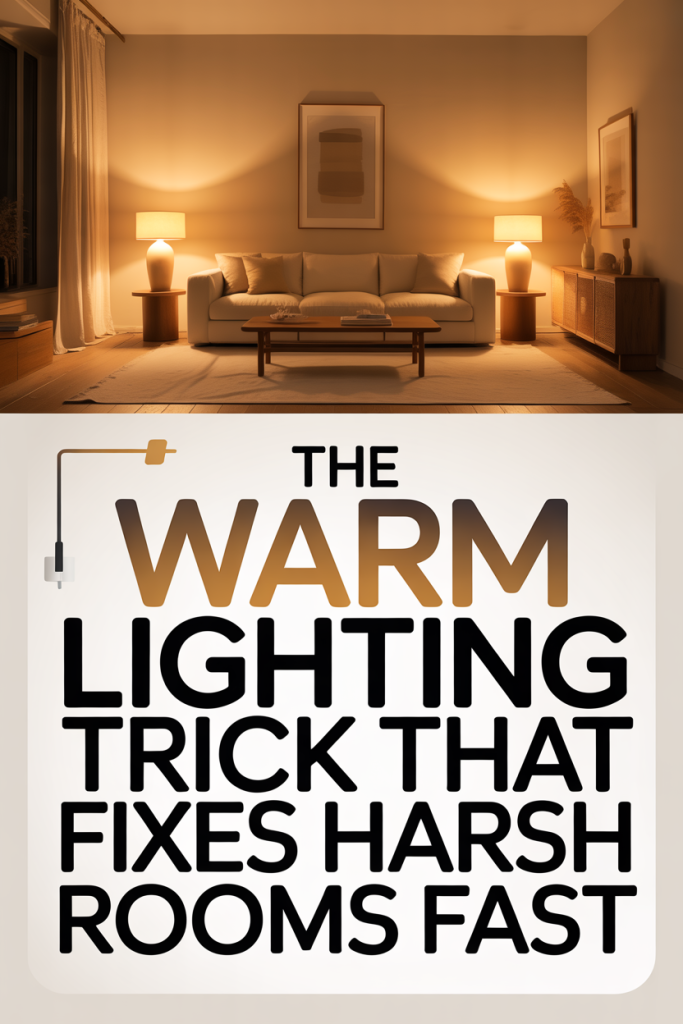
The warm lighting trick is one of the fastest, most cost-effective ways to change how a room feels. We’ve seen how cool, high-contrast light makes spaces feel harsh, why lower Kelvin and high CRI recreate a natural, flattering glow, and how diffusion and layering complete the transformation. Start with a quick assessment, swap primary bulbs to 2700K–3000K (CRI 90+), add soft diffuse fixtures and targeted task lights, and use dimmers or smart scenes to tune mood. In minutes you’ll soften the room, flatter people and surfaces, and create a space we’d actually want to spend time in. Try it tonight: swap one offending bulb, add a lamp, and notice how different the room feels.
Leave a Reply