We’ve all stood in a small room and wished it somehow felt more open, airier, less boxed-in. The fastest, most cost-effective way to change how a tiny room reads isn’t knocking down a wall, it’s changing the light. With a few thoughtful lighting choices we can alter depth, highlight architecture, and pull the eye upward and outward. In this guide we’ll walk through practical, easy-to-apply lighting tricks that help tiny rooms feel larger immediately. Expect actionable tips you can try in a weekend, including layered lighting strategies, fixture placement, mirror pairings, natural-light boosting tactics, and compact fixtures that punch above their weight. Whether you’re working with a studio, a small bedroom, or a narrow hallway, these ideas will help you make the most of every square foot.
How Light Affects Perception Of Space
Light shapes how we perceive volume, depth, and distance. When we enter a room, our brains interpret brightness, shadow, and contrast to judge how far surfaces are and how much space there is. A well-lit wall reads as farther away: a dark corner reads as closer and more cramped. That’s the basic trick we exploit: by brightening boundaries and reducing heavy shadows we can trick the eye into seeing more room than physically exists.
There are a few science-backed principles to keep in mind. First, brighter colors reflect more light, which increases perceived space: darker tones absorb light and visually pull surfaces inward. Second, diffuse light, the kind that wraps around objects, minimizes harsh shadows that make rooms feel boxy. Third, directional light creates focal points and depth: a layered approach that mixes even ambient light with task and accent sources produces dimensionality without shrinking the room.
Practically, this means we should avoid single overhead fixtures that cast downward pools of shadow, especially in tight areas. We want multiple, lower-intensity sources at different heights to spread light evenly. Also, increasing vertical illumination (lighting closer to the ceiling or up-lighting) makes ceilings feel higher: drawing light out to corners makes walls recede visually. Throughout this piece we’ll translate these perceptual rules into simple swaps and placements that deliver big impact with minimal fuss.
Layer Lighting: The Three Must-Have Layers
Layered lighting is the baseline strategy for making tiny rooms feel larger: ambient, task, and accent. Each layer serves a different visual purpose but together they prevent the flat, shadow-heavy look that shrinks space. Rather than relying on one bright bulb, we create a tapestry of light that defines zones and suggests openness.
Ambient Lighting: Set The Baseline
Ambient light is our room’s general illumination, it establishes the overall brightness we use to judge scale. For small spaces, ambient lighting should be soft but sufficient: aim for even coverage rather than a single concentrated source. We often recommend recessed downlights spaced to wash walls lightly, or a semi-flush ceiling fixture that uses multiple bulbs to spread light. When possible, choose bulbs with a neutral to warm color temperature (2700–3000K) so the space feels inviting without appearing dim. Dimmable ambient lighting is ideal because it lets us control perceived volume: brighter levels feel more spacious for tasks or social time, while gentle dimming creates cozy evenings without losing depth.
Task Lighting: Light Where You Need It
Task lighting highlights functional areas, reading nooks, kitchen counters, desks, and prevents us from over-illuminating the whole room just to see one spot. By concentrating light where activities occur we reduce glare and keep other areas softer, which enhances the sense of layered depth. Use adjustable wall sconces or swing-arm lamps beside beds and sofas: under-cabinet lighting in kitchens: and focused pendants over dining tables. Having a dedicated task source eliminates the need for a blinding central fixture, and it frames activity zones so the room feels organized and roomy.
Accent Lighting: Create Depth And Focus
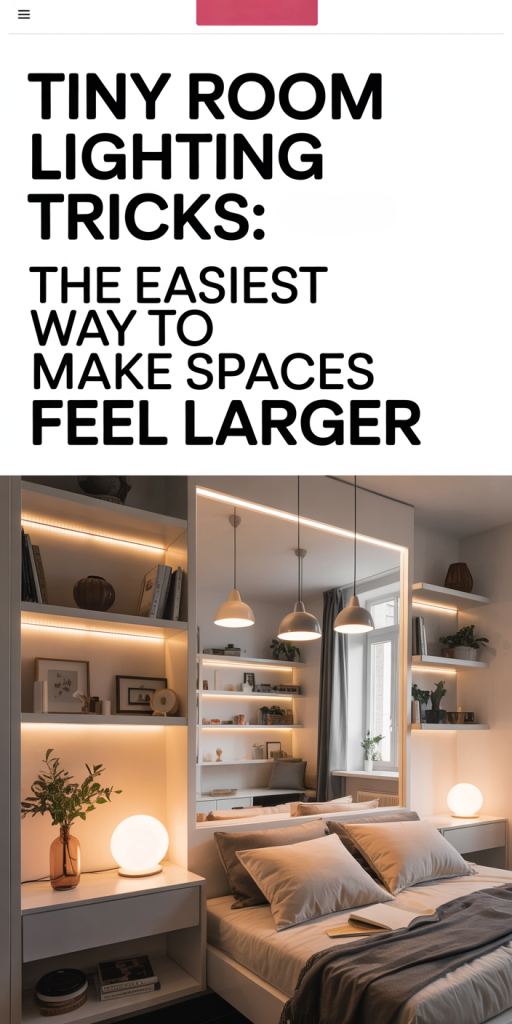
Accent lighting is the secret sauce for perceived depth. Small directional fixtures, picture lights, tiny spotlights, LED tape along coves, can draw attention to vertical planes and textures, creating deliberate highlights that trick the eye into seeing layers. We use accent lights to illuminate one wall, a bookshelf, or a plant corner: by brightening a background plane relative to the foreground, the room feels deeper. Keep accent beams narrow and purposeful: too many competing highlights create clutter. When paired with ambient and task layers, well-placed accents transform a compact room into a series of visual planes that read much larger than a single flat space.
Maximize Natural Light For Instant Opening
Natural light is the fastest route to making a room feel expansive because it’s broad, flattering, and dynamic. Our priority in small rooms is to let daylight in and distribute it evenly. Even modest increases in daylight can change perceived square footage dramatically.
Start by decluttering windowsills and trimming any outdoor vegetation that blocks glazing. Inside, position low-profile furniture away from window planes, a bench or floating shelf works better than a bulky armchair that interrupts the light path. Consider swapping heavy drapery for lighter treatments (we’ll detail options next) or forgoing curtains entirely where privacy and orientation allow.
Another practical tip: rotate reflective or light-colored furniture toward the window. A mirrored tabletop, a gloss-finish sideboard, or even a pale rug near the glass will bounce daylight deeper into the room. If you’ve got the budget and building access, enlarging a glazing opening or replacing a solid door with a glazed one transforms circulation spaces like hallways and small entryways astonishingly quickly. But for most of us, rearranging furniture and improving window treatments delivers a big return with zero construction.
Window Treatments And Reflective Surfaces To Boost Daylight
How we dress windows and choose surface finishes has a direct effect on how daylight behaves in a room. In small spaces we want treatments that let light pass while still providing privacy and thermal comfort.
Light-filtering shades, sheer curtains, or top-down/bottom-up blinds give us the best of both worlds: they keep prying eyes out while letting diffuse daylight flood the room. We avoid heavy, dark drapes that act like blackout curtains during the day: if full blackout is necessary for sleeping, keep them layered with sheers and draw them only at night.
Reflective surfaces multiply daylight. Mirrors are the obvious choice, positioned opposite or adjacent to windows they double the incoming light and visually extend the view. But smaller touches matter too: glossy kitchen backsplashes, satin or semi-gloss paint on trim, glass decor, and metallic finishes on lamps will all catch and re-emit daylight. Even high-sheen flooring or lacquered furniture can help. The trick is balance: too many reflective surfaces in a small room can feel flashy. We recommend one or two strategic reflective elements coupled with light, matte textiles to keep the effect natural and comfortable.
Scale, Placement, And Space-Saving Fixtures To Visually Expand Rooms
Fixture size and placement are crucial in tight spaces. Oversized pendant lights or floor lamps with large shades can dominate a small room and break the line of sight: compact, well-placed fixtures preserve openness and still deliver plenty of light.
Ceiling-mounted fixtures that hug the plane, flush or semi-flush lights, free up visual height. Recessed downlights provide a clean ceiling line, but we place them carefully to avoid creating a bowl of shadow in the center. For vertical expansion, uplights and wall washers are excellent: they push light up the walls and create the illusion of taller ceilings. Picture rails and narrow wall sconces mounted at eye level or higher draw the eye along the wall rather than across the floor, making the footprint feel stretched.
Space-saving fixture designs also help: LED tape hidden in coves or under shelving provides continuous light without occupying floor space: track lighting gives adjustable directionality from a single slim footprint: clip-on lamps or battery-powered puck lights add task illumination without cords or drilling. In small rooms, we often choose fixtures with smaller diameters but higher lumen output so they illuminate effectively without imposing visually.
Smart Use Of Mirrors And Glossy Surfaces To Multiply Light
Mirrors are one of the oldest tricks for enlarging space, and they’re still one of the most effective. But placement and size matter. A large mirror hung opposite a window reflects not just light but also the outdoor view, which visually doubles the perceived depth. If positioning directly across the window isn’t possible, angle a mirror to catch daylight and direct it toward darker corners.
We recommend full-length or oversized horizontal mirrors for living rooms and bedrooms: horizontal pieces widen the visual field: vertical mirrors emphasize height. Using multiple small mirrors in a gallery arrangement can read as decorative and still boost brightness, but avoid busy patterns that create visual clutter.
High-gloss and lacquered finishes act like subtle mirrors and are especially useful on low furniture like coffee tables, media consoles, or kitchen islands. Glossy tiles in small bathrooms or kitchens will reflect task lighting and daylight, amplifying perceived space. Another underused option is mirrored furniture with thin frames, they offer reflection without overwhelming the room’s style. Wherever possible, pair mirrored elements with matte textures in textiles to keep the space feeling grounded and not overly glitzy.
Conclusion
Tiny rooms don’t have to feel tight. By combining layered lighting, maximizing natural light, choosing the right scale of fixtures, and strategically deploying mirrors and reflective surfaces, we can expand perception without remodeling. Start with ambient evenness, add focused task sources, accent key planes, and let daylight do the heavy lifting. These are small interventions with outsized returns, simple swaps that transform how a room feels and functions. Try one or two of the ideas this week and you’ll notice the space opening up almost immediately.

Leave a Reply